Me: How are you doing today Professor Okutsu?
Okutsu: Good, and you?
Me: Great! The other day I was reviewing you publication on "Mars Free Return Gravity Assist From Venus" and I was intrigued.
Okutsu: I am pleased to know you read my article
Me: Yes, it just so happens I am an Aerospace Engineer major, and first year student. And I know that your Ph.D. relates to my major.
Okutsu: Yes, it does.
Me: My name is Ptah-Raet Craig, and I have been looking into gravity assist trajectories and flyby missions. I would love if I could work under you in ACURA, if you needed someone with some knowledge of astrodynamics and has read your publications. I am the perfect person, here's my business card, I can email you my resume and course history.
Okutsu: Sure.
Me: Have a great day.
Okutsu: Same to you.
Tuesday, October 23, 2018

Tuesday, October 16, 2018
WP2 & Elevator Pitch
Did Not Meet Goals
|
Meet Goals
|
Surpassed Goals
| |
Background, relates it to research
| |||
Analyze articles
| |||
Discuss the professor
| |||
Presentation is organized and shows effort, proper formatting
| |||
Elevator pitch
| |||
Genre is discussed
| |||
Length is between 5-7 mins
| |||
Total
| |||
Comments
| |||
Pitch #1
- Prepare ahead of time
- Brief
- To the point
Pitch #2
This one was from a movie scene, it was a little bit long for an elevator pitch. It did not give much background or fully meet the requirements of a good elevator pitch.
Pitch #3
- Who you are
- Background
- Explain briefly
- Connection
- Ask
- Closeout
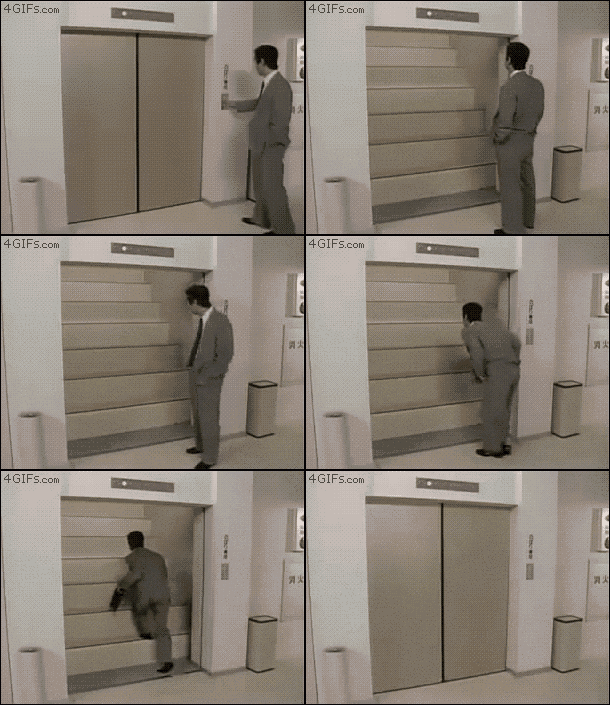
Thanks for tuning in ! Next time take the stairs.
PB2B - Analyze 2 Scholarly Journal Articles
Journal #1 - Orbital Mechanics about Small Bodies
- Scheeres, D. J. "Orbital Mechanics about Small Bodies." Acta Astronautica, vol. 72, 2012, pp. 1-14. (Link)
Journal #2 -
Both of these articles are looking at small bodies and how they react to spacecraft. Small bodies being, asteroids, comets, etc. They both are trying to find a solution to predict how these bodies will react with the spacecraft. The problem being that they would want to avoid satellites or spacecraft getting hit by these objects. Journal 2 is different in the sense that they are looking at how these small bodies at the in different zones of Earth's magnetosphere, while Journal 1 is just looking at objects in general floating in space. Journal 2 looked at currents, plasa conditions, and simulations. While Journal 1 looked at actual spacecraft floating through space. Both articles imposed that small bodies in space are unpredictable and a solution needs to be put in place to prevent these small bodies from hitting important objects in space.
Both journals had relatively the same structure, opening with the abstract, then introduction. They both do some explaining of how they would measure these things, and then they include the results of the matter, and end with a conclusion, followed by the references.
- Paul, SN, and C. Frueh. "Space-Object Charging and its Effect on Orbit Evolution." Journal of Guidance Control and Dynamics, vol. 40, no. 12, 2017, pp. 3180-3198. (Link)
Both of these articles are looking at small bodies and how they react to spacecraft. Small bodies being, asteroids, comets, etc. They both are trying to find a solution to predict how these bodies will react with the spacecraft. The problem being that they would want to avoid satellites or spacecraft getting hit by these objects. Journal 2 is different in the sense that they are looking at how these small bodies at the in different zones of Earth's magnetosphere, while Journal 1 is just looking at objects in general floating in space. Journal 2 looked at currents, plasa conditions, and simulations. While Journal 1 looked at actual spacecraft floating through space. Both articles imposed that small bodies in space are unpredictable and a solution needs to be put in place to prevent these small bodies from hitting important objects in space.
Both journals had relatively the same structure, opening with the abstract, then introduction. They both do some explaining of how they would measure these things, and then they include the results of the matter, and end with a conclusion, followed by the references.
Thursday, October 11, 2018
PB2A - Parts 3-5
Discipline - Astrodynamics
Possible Research Questions:
Possible Research Questions:
- What are the different ways we can get spacecraft to travel through space?
- Are the known methods of space travel efficient enough?
- How does magnetic force effect the orbit of a satellite?
- Astrodynamics
- Gravity Assist
- Spacecraft Velocities
- Engineering
- Space
- Orbit
- Satellite
Journal Articles:
- Scheeres, D. J. "Orbital Mechanics about Small Bodies." Acta Astronautica, vol. 72, 2012, pp. 1-14. (Link)
- Ferreira, Alessandra F. S., Prado, Antônio F. B. A, and Othon C. Winter. "A Numerical Mapping of Energy Gains in a Powered Swing-by Maneuver." Nonlinear Dynamics, vol. 89, no. 2, 2017, pp. 791-818. (Link)
- Sadler, D. H. "Satellite Orbits Astrodynamics (Orbit Determination, Space Navigation, Celestial Mechanics), Volume II. Samuel Herrick, 348 Pp., 6½ × 9¼ in., D. Van Nostrand Reinhold Co., Ltd., London, 1972. £11.50." The Journal of Navigation, vol. 25, no. 4, 1972, pp. 540-540. (Link)
- Paul, SN, and C. Frueh. "Space-Object Charging and its Effect on Orbit Evolution." Journal of Guidance Control and Dynamics, vol. 40, no. 12, 2017, pp. 3180-3198. (Link)
- AZIMOV, DILMURAT, and ROBERT BISHOP. "New Trends in Astrodynamics and Applications: Optimal Trajectories for Space Guidance." Annals of the New York Academy of Sciences, vol. 1065, no. 1, 2005, pp. 189-209. (Link)
Tuesday, October 9, 2018
PB2A - Part 1 & 2
Some disciplines that I interesting is Aerospace Engineering, Aeroacoustics, and Astrodynamics. After looking through Penn State Abington's professors, I found a professor that researches Aerospace Engineering, and Astrodynamics. Profesor Okutsu is currently interested in researching astrodynamics and gravity assist. He also designed a number of gravity assist trajectories for NASA's missions. And spent time researching human exploration of Mars.
For starters I find all of these topics equally interesting, due to my love for space and NASA. So picking just one to dedicate time and research in is not a easy pick. As a kid I've always been interested in space exploration, and the laws of gravity. But if I had to pick one I would love to do research in Astrodynamics, just because that is a topic I do not have prior knowledge of, and I love being exposed to new concepts in science. I think it would be a great opportunity for me to get an idea of the different aspects my major of Aerospace Engineering can cover. I would love to dive deeper into my major and personally, Astrodynamics could be the starting point for me.

For starters I find all of these topics equally interesting, due to my love for space and NASA. So picking just one to dedicate time and research in is not a easy pick. As a kid I've always been interested in space exploration, and the laws of gravity. But if I had to pick one I would love to do research in Astrodynamics, just because that is a topic I do not have prior knowledge of, and I love being exposed to new concepts in science. I think it would be a great opportunity for me to get an idea of the different aspects my major of Aerospace Engineering can cover. I would love to dive deeper into my major and personally, Astrodynamics could be the starting point for me.
Thursday, September 6, 2018
WP1 - Proposal
Music > Hip-Hop > Album > Tracklist


Entertainment > Social Media > Videos > Gifs

Apparel > Accessories > Hats > Dad Hats

Tuesday, September 4, 2018
PB1B : Inspecting Genre Generators
Genre generators tend to find a common ground on a particular thing (e.g., movies, comics, music, etc.) And using these generators you can find the different conventions that each of these websites have when it comes to that genre. These websites can help someone better understand genre, because they can easily see correlation within one item. If someone is on a meme generator, they can see the genre as they flip through randomized memes. With that being said, here are some conventions within different generators.
First, we have Scigen
Research Paper #1
Research Paper #2
Research Paper #3
Conventions :
- Descriptive title, related to research discussed in the paper.
- Organized formating, subtitles were used, headers, and table of contents
- Graphs and pictures were often included
- Abstract, all papers had a clear opening on the what the paper would be about
- Citations
Next, there is Comic Strips
 |
| http://pandyland.net/47 |
 |
| http://pandyland.net/104 |
 |
| http://pandyland.net/107 |
 |
| http://pandyland.net/109 |
Conventions :
- Speech/Thought bubbles
- Cartoon drawings
- Colorful pictures
- Black and white pictures
- Humor
- Boxes to show transitions
Then, we have Memes


Conventions :
- Bubble letters
- Picture as a background
- Image relates to meme or shows expression
- Used for humor
- Pictures have color to it
- Captions within pictures are normally short and to the point
Memes are used for humor in most cases, it just includes a picture. Followed by a caption on the picture. It can be a question or a statement. The picture normally relates to what the caption will be about.
Lastly, on hand picked by me, Anime Suggestions (I never even watched Anime so I felt like this would be an interesting pick)
Anime #1 - Miss Monochrome: The Animation
Anime #3 - Sakura Quest
Anime #7 - Love Stage
Conventions :
- All Anime has a picture at the top, including main characters
- The title is in front of the pictures
- Each show has a quick synopsis/description of the show
- Genre of the show is listed
- Videos included at the bottom of each
- There is also a box in the corner that gives more information on each show
"That's all for today folks. Jim cut to a commercial in tired of typing
Subscribe to:
Posts (Atom)